
A plumber's confession: what's actually growing inside the pipe behind your toilet
Twenty-eight years on the tools and somewhere north of 15,000 toilets. Here's why almost no clog happens overnight — and why the part of the pipe that causes them is the one part a brush can never reach.
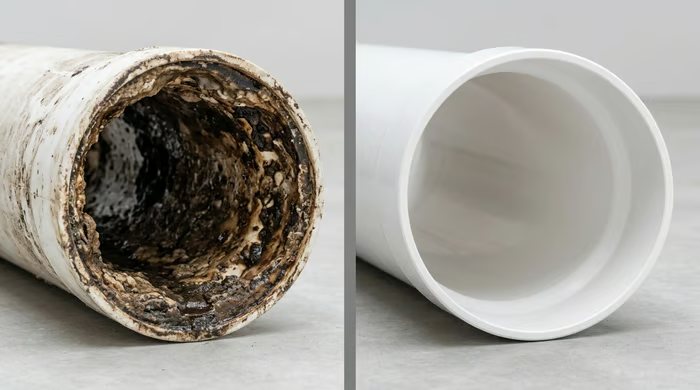
Ask a plumber what surprises people most and you will hear a version of the same answer: it is not the blockage. It is what the pipe looked like for the two years before the blockage.
The bowl is the part you can see, so the bowl is the part everyone cleans. Bleach it, brush it, and it comes up white. Meanwhile the trap and the run of pipe past it — the several feet you will never look at — are doing something entirely different.
The bit your plumber doesn't usually bother telling you
Every flush carries dissolved minerals, soap residue, paper fibre and organic waste. On a smooth new pipe, most of it keeps moving. But pipe walls are not smooth for long.
Once the first thin film establishes, it stops being a smooth surface and starts being a rough one. Rough catches more. More catches faster. It is a compounding process, which is exactly why it seems to happen suddenly — the flow stays fine right up until the moment it doesn't.
“What people think is clean, and what is actually happening six inches past the bowl, are two different worlds.”
The four stages — and why the first two are invisible
This is the part worth understanding, because it explains why the plunger under your sink is a response to stage four and does nothing about stages one to three.
-

New
Full bore
Smooth wall, full diameter, nothing catching. This lasts months, not years.
-

Months 1–12
The first film
A soft layer forms along the wall. Flow is unchanged, so nothing tells you it is happening.
-

Months 12–24
Narrowing
The channel is visibly reduced. This is when flushes start sounding different and occasionally running slow.
-

The clog
One flush too many
Something ordinary passes through and finally cannot. Nothing unusual happened — the margin simply ran out.
Note what stage four actually is. It is not the cause. It is the last day of a process that started twenty-three months earlier.
Why the bottles under your sink don't fix it
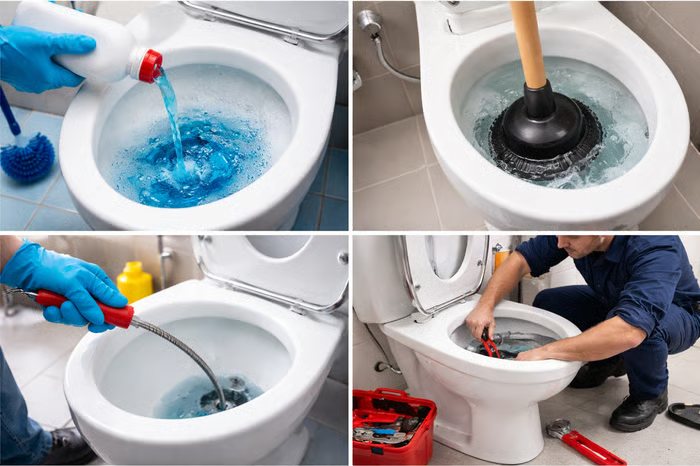
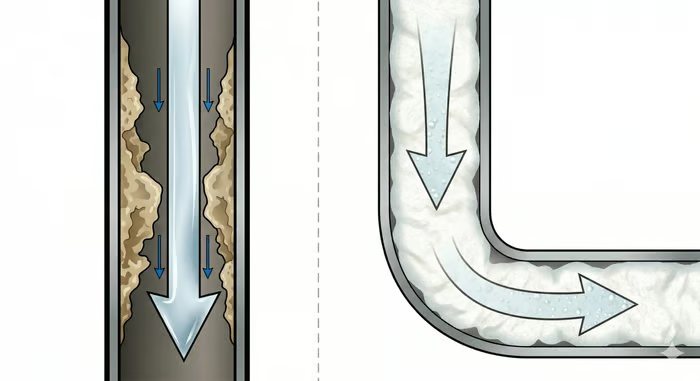
Liquid cleaner is heavier than water. Pour it into the bowl and it goes where gravity takes it — down, and away, in seconds. It spends almost no time in contact with the surface you actually needed it to work on.
A brush reaches the bowl. A plunger moves a blockage along rather than removing what caused it. An auger clears a channel through the middle and leaves the walls exactly as they were, which is why the same drain clogs again a few months later.
Caustic drain openers do dissolve organic matter — and, used often, they also attack seals, and in older systems the pipe itself. Most plumbers I have read on this are noticeably lukewarm about them for routine use.
What a foaming powder does differently
The mechanism is not complicated: the powder reacts with water and expands into foam.
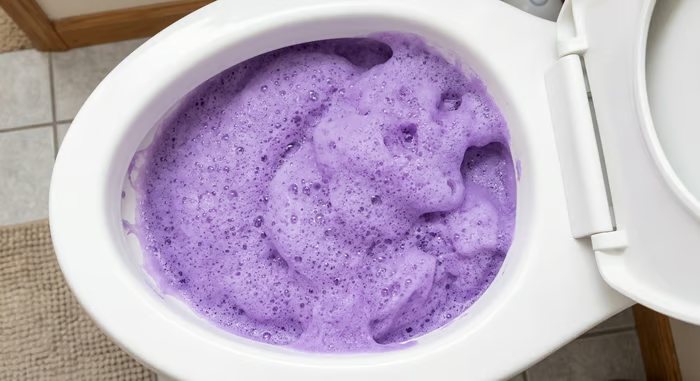
Because foam is less dense than water it does not simply sink and vanish. It expands to fill the space it is in, holds itself against the upper walls of the trap, and stays in contact for minutes rather than seconds.
Contact time is the whole argument. A cleaner that touches the deposit for four seconds and a cleaner that sits against it for fifteen minutes are not doing the same job, whatever the active ingredient.
The part that isn't really about clogs
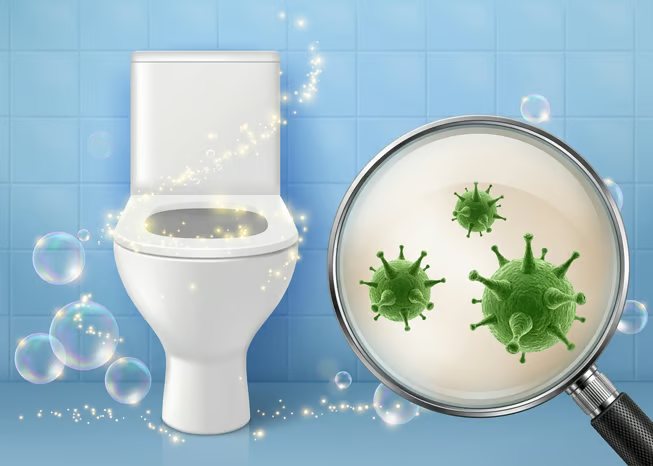
A build-up layer inside a warm, wet, permanently fed pipe is a habitat. That is where recurring drain smell comes from — not the bowl, which you have just bleached, but the film several inches past it that the bleach never reached.
If your bathroom smells again a day after cleaning, this is very often why. You cleaned the visible half of the problem.
The product this keeps coming back to
The foaming powder that turns up most often in this category is sold as FizzClean, marketed on exactly the mechanism above — “let foam handle the dirty work for you.” Its published claims are narrow enough to be worth listing:
- Dissolves tough stains in about 20 minutes
- Kills 99.9% of odour-causing bacteria
- Deep cleans the full bowl, not just the waterline
- Septic-tank safe, non-toxic and skin-friendly
Those are the manufacturer's own figures rather than independent test results, so read them as claims. What they do describe is the thing that matters here: a cleaner formulated to hold contact for twenty minutes instead of draining away in four seconds.
FizzClean is sold direct — counterfeits are common on marketplaces
Check availabilityRedirects to the official FizzClean store · 70% off while stock lasts
What people report after the first use
The seller's own listing shows a 4.7-star average across 1,887+ verified reviews, with 97% of reviewers saying they would recommend it. The mixed reports are the more useful ones:
“Our downstairs loo had a smell we'd stopped noticing until it went. That was the thing that convinced me, not the flushing.”
“Flush sounds normal again after two applications. I'd have liked clearer instructions on how long to leave it.”
“Did nothing for the actual blockage I already had — needed a plumber for that. Using it since to stop it happening again.”
A foaming maintenance powder is preventative. If you already have a full blockage, standing water or a suspected damaged pipe, call a plumber — no cleaner is a substitute for that.
Where it works besides the toilet
- Toilet traps and soil pipes
- Kitchen sink drains
- Shower and bath wastes
- Basin and utility drains
- Bathtubs and shower tiles
- Sinks and countertops
- Garbage disposals
- Grout, limescale and rust marks
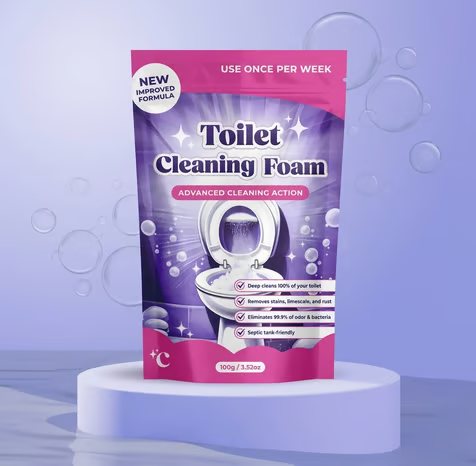
FizzClean foaming toilet & drain powder
One dose per drain, roughly once a week · 70% off while stock lasts
Check availabilityShips from the US · 30-day money-back guarantee